AI-powered voice assistants are rapidly becoming the invisible engine behind smoother days, faster decisions, and more delightful customer experiences. By leveraging contact center AI boosting agent performance with intelligent tools, these assistants help businesses optimize workflows and respond to customer needs more efficiently. With simple voice commands, they help you manage tasks, find information, control devices, and streamline work – all hands-free, showing clearly how AI is improving call center efficiency.
Beyond everyday tasks, AI-powered voice assistants are now central to the evolution of modern business and technology. In the realm of cloud-based artificial intelligence platforms for scalable computing and real-time data processing, these systems connect with vast networks of information to deliver faster insights and smarter automation. They integrate seamlessly with advanced computer technology for predictive analytics and automated decision-making, making interactions more natural and reliable for both users and businesses.
In business strategy, AI-powered voice assistants are helping companies transform their approach to personalized marketing campaigns driven by artificial intelligence and data analytics. They can analyze customer behavior, optimize advertising reach, and provide tailored recommendations, showing the power of digital marketing strategies enhanced with AI for audience targeting and engagement. Meanwhile, in the financial sector, AI-powered tools assist with automated financial analysis and risk management using intelligent algorithms, improving accuracy, efficiency, and speed in operations like fraud detection, portfolio management, and compliance monitoring.
By bridging innovations in smart enterprise technology for operational efficiency and customer experience enhancement, AI-powered voice assistants are not just personal helpers—they are key enablers of digital transformation. Whether for managing tasks, improving marketing performance, or supporting financial decision-making, they demonstrate how AI can be a versatile tool across multiple industries.
Whether you are a busy professional, a customer-focused business, or an organization looking to harness cutting-edge technology, an AI powered voice assistant can quickly become your most reliable digital companion - connecting everyday convenience with broader business innovation and technological advancement.
Top 10 AI-Powered Contact Center Solutions for Smarter Customer Experience
When it comes to improving customer service efficiency, leveraging AI-powered voice assistants has become a game-changer. The following list highlights the top contact center solutions that help businesses automate interactions, enhance agent performance, and deliver exceptional customer experiences.
1. Bright Pattern – Leading AI Contact Center Platform
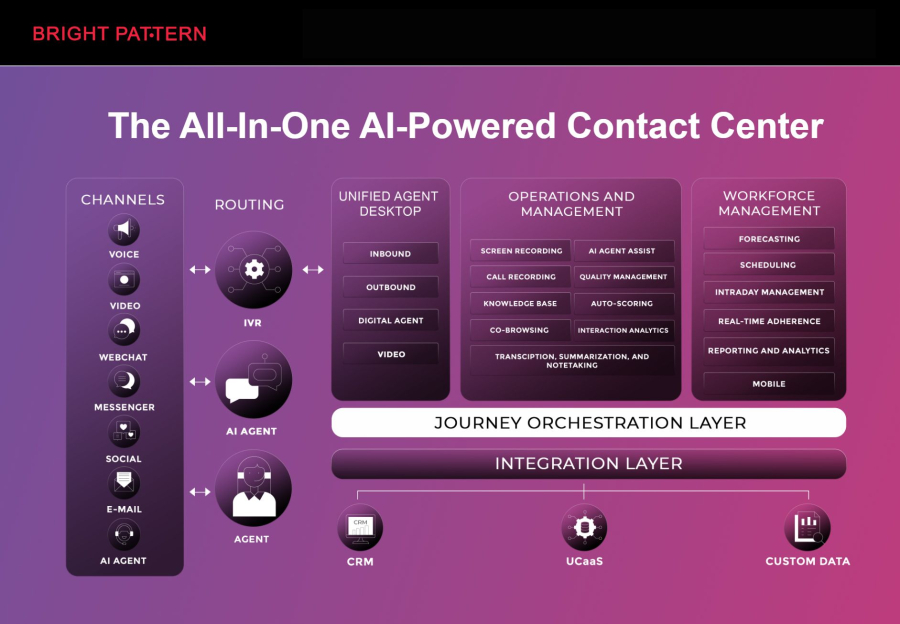
Bright Pattern stands out as a top choice for businesses seeking advanced AI contact center solutions. Its platform combines intuitive design with powerful automation to deliver seamless customer service across multiple channels. With AI-powered voice assistants integrated into its system, agents can focus on high-value tasks while the platform handles routine inquiries and data collection.
Key features of Bright Pattern include:
- Omnichannel support: Manage voice, chat, email, and social messaging in one platform.
- Intelligent routing: Automatically connects customers to the best-suited agent based on skills and history.
- AI-powered voice assistant integration: Reduces call times and improves first-contact resolution.
- Advanced analytics and reporting: Gain insights into agent performance and customer satisfaction.
- Seamless CRM integration: Connects with Salesforce, HubSpot, and other tools for unified customer data.
Bright Pattern’s platform is designed to optimize workflows, boost agent productivity, and enhance the overall customer experience using AI-powered voice assistants for smarter interactions.
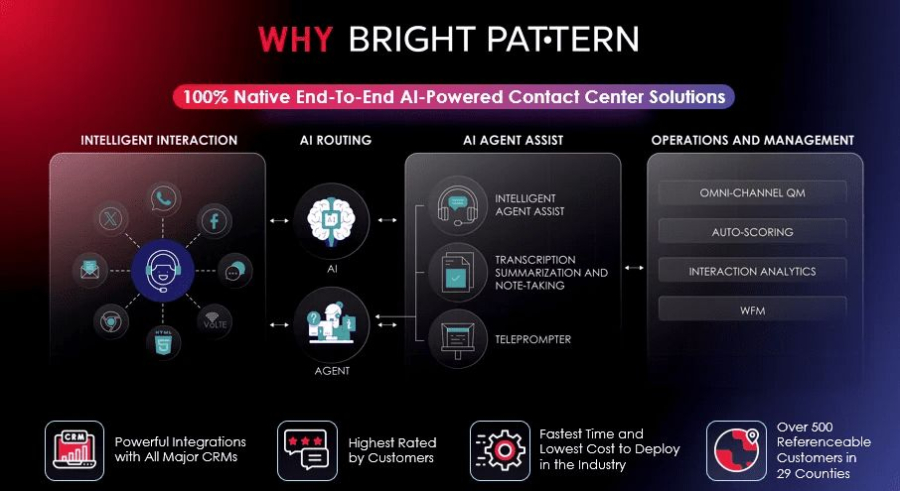
2. Five9 – Cloud Contact Center Solutions
Five9 offers a cloud-based contact center platform with AI-enhanced routing and virtual assistants. Its intelligent automation helps agents handle high volumes of customer inquiries efficiently.
3. Genesys – AI-Driven Customer Experience Platform
Genesys provides AI-powered virtual assistants and predictive routing to improve customer satisfaction. Its omnichannel platform ensures consistent support across all channels.
4. NICE inContact – Cloud Contact Center Suite
NICE inContact delivers AI-enabled workforce optimization and virtual agent capabilities, helping businesses manage calls and messages effectively while supporting agent performance.
5. Talkdesk – AI-Powered Customer Service Software
Talkdesk combines AI-driven analytics with virtual assistants to reduce call times, improve routing, and offer personalized customer experiences across multiple channels.
6. RingCentral – Intelligent Cloud Contact Center
RingCentral’s contact center platform integrates AI tools for automation, real-time insights, and enhanced voice assistant capabilities to streamline customer interactions.
7. 8x8 – AI-Enhanced Contact Center Platform
8x8 uses AI-powered virtual agents and predictive analytics to provide personalized service and efficient handling of customer inquiries.
8. Cisco Webex Contact Center – AI-Powered Service Platform
Cisco Webex Contact Center integrates AI for routing, voice transcription, and virtual agent assistance to improve resolution times and agent productivity.
9. Amazon Connect – Cloud-Based AI Contact Center
Amazon Connect leverages AWS AI services to create smart virtual assistants, intelligent call routing, and automated workflows for enhanced customer support.
10. Avaya OneCloud – Intelligent Contact Center
Avaya OneCloud provides AI-assisted customer service, including chatbots and voice assistants, to optimize agent efficiency and ensure smooth, consistent customer experiences.
What Is an AI-Powered Voice Assistant?
AnAI-powered voice assistantis a software application that uses technologies like automatic speech recognition, natural language processing, and machine learning to understand spoken language and respond intelligently. You talk to it, it interprets your request, and then carries out actions or provides answers in real time.
Unlike traditional voice systems that only recognize a limited set of commands, modern AI assistants can handle more natural speech, understand context, and improve over time from ongoing use.
Key Capabilities That Make AI Voice Assistants So Powerful
Today’s AI-powered voice assistants do far more than set timers or play music. They combine multiple technologies into a single, intuitive experience. Here are the capabilities that make them stand out.
1. Natural Language Understanding
Modern assistants usenatural language understandingto interpret the meaning of your words, not just the exact phrasing. This means you can ask for the same thing in multiple ways and still be understood. For example:
- "Remind me to call Sam at 3."
- "Set a reminder to phone Sam this afternoon at three."
An AI assistant recognizes these as the same intention and sets the appropriate reminder.
2. Context Awareness
Many AI voice assistants are designed tokeep track of contextacross a conversation. Instead of repeating details, you can speak naturally, just as you would with a person. For instance, you might say:
- "What is on my calendar this afternoon?"
- "Move the second meeting to tomorrow morning."
The assistant can infer that "the second meeting" refers to an item from your previous request. This context awareness makes voice interactions smoother and more efficient.
3. Multi-Channel and Multi-Device Support
AI-powered voice assistants can live in many places at once: on your phone, smart speaker, laptop, car infotainment system, or even inside business apps. Thismulti-device presencegives you a continuous, connected experience.
Ask for directions on your smart speaker at home, then have your phone pick up the navigation as you head out the door. Or start dictating notes on your smartwatch and finish reviewing them on your laptop.
4. Task Automation and Integrations
Voice assistants become truly powerful when connected to the apps and tools you already rely on. With the right integrations, you can use voice to:
- Create and update calendar events.
- Send messages or emails.
- Manage tasks in your to do or project management tools.
- Control smart home devices like lights, thermostats, or locks.
- Pull quick updates from CRM, help desk, or collaboration platforms.
This level of automation saves time and reduces friction, especially for recurring, low value tasks.
5. Personalization and Learning Over Time
A well designed AI assistant is not just smart, it ispersonalized. Over time, it can adapt to your preferences, routines, and vocabulary. It might learn:
- Which news sources you prefer in the morning.
- Who "Sam" or "Alex" refers to in your contacts.
- How you like your daily briefing structured.
- Which music genres you choose for workouts or deep work.
This personalization transforms the assistant from a generic tool into a tailored companion that feels increasingly intuitive and helpful.
Top Benefits of AI-Powered Voice Assistants
The true value of AI voice assistants lies in the real world benefits they unlock for individuals and organizations. Here are the most impactful advantages.
1. Hands-Free Productivity
One of the biggest strengths of an AI voice assistant ishands-free control. While cooking, driving, exercising, or working with your hands, you can still:
- Set timers and reminders.
- Dictate messages or notes.
- Check your calendar and reschedule meetings.
- Look up quick facts or instructions.
This ability to stay productive on the move turns previously idle moments into opportunities for progress.
2. Faster Access to Information
Instead of typing and navigating through menus, you simply ask a question. The assistant quickly searches, interprets, and summarizes the most relevant information. This leads to:
- Faster decision making at work.
- Less time spent clicking through interfaces.
- Rapid answers to everyday questions, from weather to travel plans.
By streamlining the path between question and answer, AI assistants help you stay focused on what truly matters.
3. Enhanced Accessibility and Inclusion
AI voice assistants can be a powerful ally for people with visual impairments, mobility challenges, or other conditions that make traditional interfaces difficult. Withvoice-first interaction, users can:
- Operate devices without relying on screens.
- Dictate messages and documents instead of typing.
- Control smart environments more independently.
This contributes to more inclusive digital experiences and opens up technology to a wider audience.
4. Smoother Customer Experiences for Businesses
For organizations, integrating an AI-powered voice assistant into customer journeys can dramatically improve service quality and satisfaction. Voice based interactions can:
- Handle routine inquiries 24/7, from order status checks to account balances.
- Guide customers through self-service flows using natural conversation.
- Reduce wait times by answering common questions instantly.
- Free human agents to focus on complex, high value cases.
The result is a more responsive, efficient support experience that leaves customers feeling heard and helped.
5. Consistent, On-Brand Interactions
AI assistants can be configured with a specific tone of voice, vocabulary, and style, ensuring that every interaction reflects your brand. This consistency builds trust and reinforces your identity at every touchpoint.
Whether a customer speaks to your assistant on a smart device, in a mobile app, or via a contact center, they receive the same reliable, on brand guidance.
Popular Use Cases for AI-Powered Voice Assistants
AI voice assistants are highly adaptable, supporting a wide spectrum of scenarios in both personal and professional environments.
At Home
- Smart home control– Use your voice to manage lighting, heating, blinds, and security devices, creating comfortable scenes on demand.
- Daily planning– Ask for traffic updates, weather forecasts, and calendar briefings as you start your day.
- Entertainment– Play music, audiobooks, podcasts, or trivia games without touching a remote.
- Family coordination– Set shared reminders, shopping lists, and household to do items that everyone can access.
On the Go
- Driving assistance– Get turn by turn directions, change routes, or find nearby services while keeping your hands on the wheel.
- Mobile productivity– Dictate messages, capture ideas, or schedule meetings between appointments.
- Travel support– Check flight updates, translate phrases, or review itineraries through simple voice requests.
In the Workplace
- Meeting support– Ask the assistant to schedule meetings, book rooms, summarize agendas, or capture action items.
- Information retrieval– Quickly pull up metrics, sales numbers, or project updates from internal systems.
- Note taking and documentation– Dictate reports, draft emails, or log customer interactions by voice.
- Workflow shortcuts– Trigger standard processes, such as opening tickets or logging support cases, with simple spoken commands.
In Customer Service and Sales
- Voice-based self-service– Let customers get answers instantly via natural conversations instead of complex menus.
- Intelligent call routing– Automatically understand caller intent and direct them to the right department or resource.
- Sales assistance– Support sales teams with quick access to product details, pricing information, and customer histories through voice.
Core Technologies Behind AI Voice Assistants
Several key technologies work together to create a seamless voice experience. Understanding them helps clarify how AI assistants deliver such powerful results.
Technology | What It Does | Benefit for Users |
Automatic Speech Recognition (ASR) | Converts spoken language into text that a system can process. | Accurately captures what you say, even with different accents or speaking styles. |
Natural Language Understanding (NLU) | Interprets the meaning and intent behind the words. | Lets you speak naturally, without memorizing specific commands. |
Dialogue Management | Controls the flow of the conversation and keeps track of context. | Supports multi step interactions that feel coherent and human like. |
Natural Language Generation (NLG) | Creates clear, human readable responses from structured data. | Delivers concise, understandable answers and instructions. |
Machine Learning | Improves models over time based on usage patterns and feedback. | Makes the assistant more accurate, responsive, and personalized. |
Text-to-Speech (TTS) | Transforms text responses into spoken audio. | Provides natural sounding voice replies you can listen to anywhere. |
Designing a Voice Experience That Users Love
To unlock the full potential of an AI-powered voice assistant, thoughtful experience design is essential. A well designed assistant feels intuitive, friendly, and reliable. Here are best practices that help create that experience.
1. Start With Clear, High-Value Use Cases
The most successful voice assistants focus on a set ofhigh impact tasksfrom day one. Common examples include:
- Checking account or order status.
- Answering frequent product or service questions.
- Scheduling and reminders.
- Controlling key smart devices or business tools.
By starting with clear, high value scenarios, you quickly demonstrate the assistant’s benefits and drive adoption.
2. Make Interactions Natural and Conversational
Users should feel they can speak naturally, without having to remember strict command structures. To achieve this:
- Support multiple phrasings for the same intent.
- Handle simple follow up questions without repeating context.
- Give clear prompts when the assistant needs more information.
The more conversational the experience, the more confident users become in relying on voice.
3. Provide Helpful Guidance and Feedback
When people are new to a voice interface, they appreciate gentle guidance. Effective assistants:
- Offer quick examples of what you can ask.
- Confirm important actions, such as sending a message or making a booking.
- Summarize results clearly before ending the interaction.
This builds trust and reassures users that the assistant understood them correctly.
4. Keep Responses Clear and Concise
People turn to voice for speed and convenience. Responses should be:
- Short enough to follow easily.
- Structured logically, with the most important information first.
- Action oriented, clearly stating next steps when needed.
This clarity makes interactions feel efficient and satisfying.
Why Now Is the Right Time to Embrace AI Voice Assistants
AI-powered voice assistants are no longer experimental. They are a mature, proven technology used every day in homes, cars, offices, and customer service operations around the world. Several trends make this the ideal time to invest in voice experiences.
- Improved accuracy– Advances in speech recognition and language models have dramatically boosted reliability, even in noisy environments.
- Wider device availability– From smartphones to smart speakers and connected appliances, voice interfaces are now embedded in many everyday devices.
- Growing user comfort– People are increasingly comfortable speaking to technology, thanks to years of gradual adoption and positive experiences.
- Demand for frictionless experiences– Customers and employees alike expect fast, intuitive, and personalized interactions across channels. Voice fits this expectation perfectly.
By adopting AI-powered voice assistants now, individuals gain an immediate productivity boost, while businesses position themselves as modern, user centric, and innovation driven.
Getting Started With an AI-Powered Voice Assistant Strategy
For organizations looking to introduce or expand their use of AI voice technology, a thoughtful rollout plan ensures strong results from the start. Consider these steps.
- Define your objectives.Clarify what success looks like, such as faster response times, higher self service rates, or improved employee productivity.
- Map your user journeys.Identify where voice can remove friction, shorten steps, or make key tasks more accessible.
- Prioritize high impact use cases.Launch with scenarios that offer clear, measurable value and are technically achievable with your current systems.
- Integrate with core tools.Connect your assistant to calendars, knowledge bases, CRMs, ticketing platforms, or smart devices to unlock powerful automations.
- Test with real users.Pilot the experience with a focused group, gather feedback, and refine conversational flows before broad deployment.
- Measure and optimize.Track usage, completion rates, and satisfaction scores, then continuously refine intents, responses, and capabilities.
This structured approach ensures your AI-powered voice assistant delivers meaningful, visible benefits from day one and continues to improve over time.
AI-Powered Voice Assistants as a Strategic Advantage
Voice is more than a convenience feature. It is a strategic capability that can reshape how people interact with technology, how teams work, and how brands serve their customers.
For individuals, an AI voice assistant becomes a trusted helper that remembers, organizes, and retrieves information on demand, freeing you to focus on higher impact work and more meaningful experiences.
For organizations, voice assistants unlock new efficiencies, elevate service quality, and demonstrate a commitment to innovation that customers and employees notice.
As AI capabilities continue to advance, the voice assistant you use today will only become smarter, more capable, and more deeply woven into your daily life. Now is the perfect moment to embrace this technology and discover just how much smoother and more productive your world can be with an AI-powered voice assistant by your side.
